
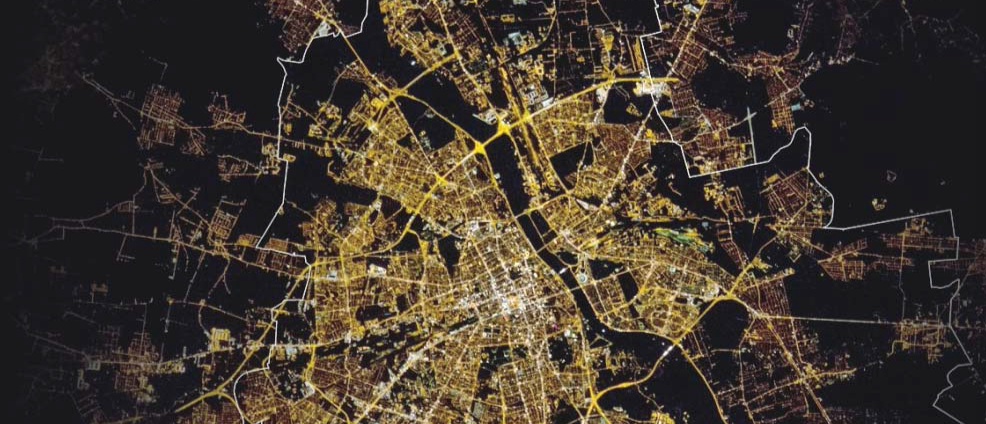
HOW TO CREATE A NEW FACE OF THE CITY AFTER DUSK?
The use of light in shaping the image of cities (also for marketing purposes) is not a new phenomenon, although unplanned and conceptually use of this tool may contain certain dangers. The image of the city at night is one of the very important elements contributing to the creation of the city’s identity and identification. American architect Kevin Lynch intensively researched the structural relationships in cities, their presence and tried to explain how people orient themselves in urban agglomerations and what they remember when leaving them.
The result was the listing of the basic elements of the city’s spatial structure that emerged from this study: communication routes, areas, borders, focal points, squares and hallmarks of a given city (characteristic buildings).

The aim of the Masterplan is to identify all these urban elements and highlight with light (both decorative and functional light) their importance in creating a night-time, orderly image of the agglomeration.
Based on Studio DL’s 10 rules for creating lighting masterplans for cities, modeled on, among others, based on Kevin Lynch’s statements, we present below the taxonomy according to: where the first part of the Masterplan development is carried out.
Communication routes/Roads (1) According to Kevin Lynch, roads are tunnels through which observers of the city travel. The correspondence of the visual hierarchy with the functional hierarchy, the aesthetic and topographic quality, and the orientation in the street system must be recognizable. The differences between functional communication arteries and representative streets should be visible through different heights of the light source, distances of masts and their proportions.


Areas/Places/Focal Points (2) Squares and Focal Points are places where streets converge, various functions in space are concentrated and a unique atmosphere prevails, they play an important role in urban agglomerations. These areas should receive appropriate lighting, corresponding to the function of a given space, which will take into account the influence of substances surrounding the square, small architecture, vegetation and take into account the directions of observations in the context of the city.
Hallmarks/Distinctive buildings (3) Building facades in representative, central parts of cities should be slightly brightened during main traffic hours at night. Recognizability of the city’s character is an important feature that helps the observer in orientation. Individual important objects play a special role in creating the identification of cities. Vertical, cold lighting of buildings, contrasting with horizontal, warm street lighting, guarantees quick readability.


Boundaries (4) In order for the night image of the city center to highlight its identity, its boundaries must be marked and emphasized. After the abolition of defensive walls in cities and the liquidation of entrance gates, there are no clear and visible entrances to cities. However, with careful observation and analysis of the center, one can notice in every urban agglomeration certain elements such as bridges, characteristic buildings or architectural entrances that form the beginning of the city. These elements should have a different light color or intensity, and the ambient lighting should be extended to the border points.